












|
|||||||||
|
|
|
|
|
|
|
|||
| |
|
|
|
||||||
| |
|||||||||
| |
|
|
|
|
|
|
|
|
|
Further information, on all of the inspection locations across the country, is listed below the flyer.
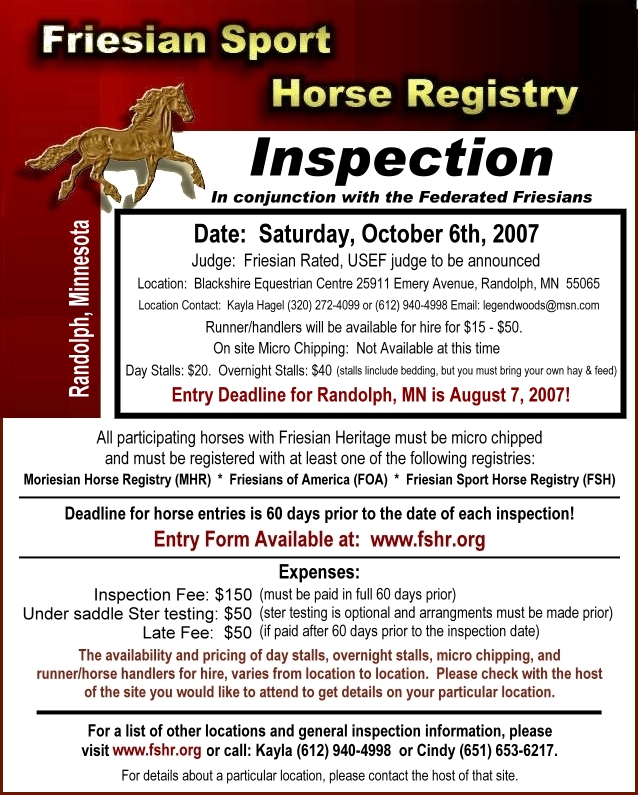
The Date for Randolph, MN has been changed to Sunday, October 14th, 2007!
General Inspection Information & FAQ's
Inspection Entry Forms available at: Inspection Entry Form
Deadline for horse entries is 60 days prior to the date of each inspection!
Payment:
Make checks for $150.00 per horse payable to:
Federated Friesians and mail to:
Kayla Hagel, Director of FSH Inspections 1266 150th Avenue, Ogilvie, MN 56358
Visa, MasterCard and Discover are also accepted - see entry form or call (612) 940-4998
Horse entries must be paid in full 60 days prior to the inspection date, or a $50 late fee will be applied.
Some Inspection Basics:
Horses should be sparkling clean, healthy, and sound for the inspection. They are to be presented in clean, appropriate tack. ALL horses except suckling foals under 6 months of age must present a valid Coggins test upon arrival at the inspection venue. Suckling foals need not have a Coggins but their dams must have valid Coggins tests. Horses are first presented standing while the judge evaluates conformation. This will require the horse to stand still while the judge walks around for several minutes. The judge may touch the horse but will ask for permission. At the judge's direction, the runner then walks the horse in a clockwise direction around a triangle whose sides measure approximately 75', 100' and 75' . Most horses will go around the triangle twice, at the judge's request. (the runner's goal is to show off the horse's best, ground-covering stride). The horse is then trotted around the same triangle in the same direction, usually twice. At the judge's request, the horse is then turned loose in an enclosed arena to trot and canter at liberty. The runner may encourage the horse. At the judge's request, the runner re-attaches the lead shank and takes the horse from the arena. Inspection is then completed.
Judging Divisions and Ster testing under saddle:
When shown on the Sporthorse standard, Purebred & Partbred Friesian horses will be judged to the Sport Horse standard, with Friesian influence given consideration. When shown on the purebred standard, Purebred & Partbred Friesians horses will be judged to the Friesian breed standard where any deviation from the purebred standard, including color, will result in a loss of points.
Owners may choose which standard they wish their horse to be judged against or choose to show against both the Purebred standard and the Sport Horse standard. The 1st standard is $150 and the 2nd standard, for the same horse on the same date and location, is an additional $50. These options are available because there are now Partbred horse's that have a high percentage of Friesian blood and some owners would like to know how they compare to the purebred standard and there are some owners of Purebred Friesians who would like to know how well their Purebreds match the Sporthorse type. Please be aware that if you choose to present a Partbred Friesian against the purebred standard, there will be no allowance for non-Friesian traits, including color.
There are 4 Inspection Divisions available:
Horses are scored 40% on conformation and 60% on movement. For horses that qualify, first, second and third place Premiums are given and ribbons are awarded.
Scores: 9.0 = excellent…..7.0 = good…..5.0 = acceptable…..3.0 = poor…..1.0 = very poor
Premiums: Third (6.0 – 6.9) Second (7.0 – 7.9) First (8.0+)
Optional Ster performance testing under saddle is also available, for Purebreds and Partbreds over 3 years old, for an additional $50.00 charge. Prior arrangements must be made. Ster performance testing requires the horse to perform movements equivalent to USDF Training Level Test Four. Order of the movements will be verbally requested by the judge.
A New Idea for this year's tour – Breeding Suitability Inspections:
This year, the FSH is adding a "breeding suitability" division of inspection at some of the locations. This would be a division of inspection for non-Friesian horses of any registry/breed (or unregistered). All horses entered will be judged separately from the main (Friesian-type) inspection and would be judged on a non-breed specific, sporthorse standard. The goal of this division is to judge and give a score for the suitability and quality of non-Friesian broodmares and stallions that are being used to produce Friesian Sport Horses. Broodmares would not be required to be in top physical conditioning (the judge would be instructed to take into account that the horse is a broodmare and not currently a performance horse) However, any horse that wants to be judged on a sporthorse standard may participate. Most of these horses would be non-Friesian, but broodmares with Friesian blood may also choose to participate in this category.
The breeding suitability division is a new idea that has come about by specific request of members. Some would like to have the judges opinion on the quality of their non-Friesian mares/stallions and others would like their broodmares to have an opportunity to be judged without taking a year off from breeding or going through an intensive conditioning program. Please let us know if you would be interested in participating in the breeding suitability division.
Attire for the horse:
You may want to bath and groom your horse prior to the inspection, to show him in his best condition. For FSH registered horses, you may braid the mane and clip a bridle path, but braiding and clipping are not required. Purebred horses are strongly encouraged to show without braiding. These requirement are different for different registries, please be sure to check your registries requirements. FOA horses are not allowed to braid. Horses do not have to have shoes. Any type or color of halter is permissible. It is a good idea, however, to stay away from bright colors and stay with the tones of the horses base color. Foals, yearlings and two year olds will have to be brought into the arena with a halter. Horses over three years of age and older must be shown in a bridle with a snaffle bit. Injuries and scars are not considered in the inspection as long as it does not interfere with the horse’s movement, contours or health of the horse. A horses training is not judged, but you must be able to get the horse to stand long enough for the conformation to be judged and move at walk trot and canter. Young foals may be released at judges request to perform the rest of the inspection.
Runner/Handlers: Will there be runners available? Are they required? Do I need to contact the runners in advance? How do I do that? Who will be the runner at each site? What is the cost of hiring a runner?
You should call the coordinator/host, at the site you are interested in, to find out the details of what they are offering at that particular site. The registries do not provide runners, but an individual site might have some lined up and available for hire. You may use a handler as well as a runner if you feel this will enhance your horse's performance, but it is not necessary and in some cases it is detrimental to the horse's performance. It is perfectly acceptable to show your horse yourself. The judge is evaluating the horse, not the presenter(s).
If you would like to hire a runner/handler, you will be responsible for independently contacting these people prior to the start of the inspection and making arrangements with them. Or, you may bring in your own handler from your own resources . We make no guaranties as to the credentials of the individuals available for hire at the inspection sites. They may simply be younger adults that have little prior show experience, but are capable of keeping up with the gaits of the horses. The fee for the runner/handler varies from location to location and has no connection whatsoever to the Friesian Sport Horse Registry or the Moriesian Registry.
What is the appropriate attire for the runners/handlers ?
White or tan colored pants and a white shirt are usually inspection standards. However, if you happen to have a light colored horse, you may wish to show your horse in dark colored clothing. Please keep in mind that the idea is for the judge to see the outline of the horse, not your brightly colored clothing. Solid clothing is preferred: white or tan and black or dark blue. Please wear shoes suitable for running.
Who Can Participate?
These inspections are open to horses of Friesian heritage that are registered with any registry that is a member organization of the GMO, Federated Friesians (FF). Currently, those registries are the Friesian Sport Horse Registry (FSH), Friesians of America (FOA) and the Moriesian Horse Registry (MHR). If you are registered with a different Friesian-based registry, you can encourage your registry to join FF.
Additionally, the Open, breeding suitability division allows non-Friesian horses, regardless of registration, to participate. No registration or micro chip is required for non-Friesian horses to participate in the Open Breeding Suitability Division. There will be a 1-day, temporary FSH membership fee, of $5 per horse, for people who are not currently a member of one of the FF affiliated registries.
What is Federated Friesians?
FF is a GMO program for organizations that have Friesian-specific organizational bylaws, that document the Friesian breed or its derivatives, and that offer services to their members. The FF GMO program is designed to do only two things: 1) allow sharing of data and 2) promote sharing of resources.
You can read more about it here: http://www.legendwoods.com/newsLinks.html - just click on the FF link on the left side of the page.
What is the point of having a horse inspected and is it required?
Many people have been emailing with questions like, “do we have to have our horse inspected and why should I have my horse inspected, what is the advantage?” Or, “how would inspecting my horse benefit my horse?”
First, please note that a variety of registries REQUIRE that registered horses be inspected at some point in the horse's life. These registries include the Friesian registries FOA, FHANA, and FPZV, among others. At this time, inspections for FSH and Moriesian are OPTIONAL only. It is generally viewed as a good way to assess the quality of the horses breeding and producing offspring within a registry. Inspections also help to educate breeders and buyers about the type and quality they are aiming to produce or buy. The FSH has decided to have inspections be an optional service available to their members who would like it. No one within the FSH is required to participate.
Some owners find these inspections useful in terms of having the horse(s) professionally evaluated for conformation and for potential for various disciplines. They are particularly useful as a marketing tool. Buyers often find a horse with a good inspection score more appealing than a horse without one. For breeders, it helps to establish the overall quality of their breeding programs and often, helps them to see where improvement is needed. We all can be prone to loving our own horses and can sometimes fall victim to becoming “barn blind”. The hope is that responsible breeders will use the “optional” inspections as a tool to help them keep the quality of their horses high, thereby keeping the quality of the registry high and the value of the horses up.
Another question that we have been hearing is, “does one do an inspection for a gelding or is it a moot point?” Geldings can be inspected for the same exact reasons as mares and stallions. They are a reflection of a breeding program. Even if they themselves will not produce offspring, perhaps an owner is considering repeating the breeding to produce a full or half sibling? Owners of geldings are also often curious as to the suitability of their geldings and geldings are routinely put up for sale – inspections of geldings can be a benefit to the horse and/or the owner for many reasons.
Facility:
In Minnesota, stalls are available on a limited basis. The facility in MN is offering stalls for the day for $20.00 per stall. Shavings are provided but, you must bring your own hay and feed. For horses that are from out of town, who need a stall from Friday night through Saturday, to the closing of the inspection, the price is $40.00. Arrangements may be made for stalling past inspection hours. For facility pricing & information on all locations other than MN, please contact the host of your site.
We are asking that people donate the use of their facility for inspection sites. If you have a facility you could donate, please let us know. Each facility must have an indoor arena that is safe to turn horses at liberty in – every horse inspected has an “at liberty” portion of inspection – all ages and stallions too. Currently, we are looking for people to host sites in Kentucky (maybe near Lexington or Louisville) and Wisconsin (likely in North-Eastern WI). If you can help us out in either of these areas, please let us know ASAP. We also have quite a bit of interest from the following locations: Kansas, Ohio, Arizona, Maryland, North Carolina & South Carolina. If enough horses can be gathered in these areas, we could add dates for these locations as well.
Micro Chipping:
Micro chips are required for all Friesian heritage horses being inspected. Your local vet may insert them and AVID is one of the accepted brands. AVID is the most popular micro chip so most vets should have them. Please check with us if your vet handles a different brand. Micro chips are inserted by a needle into the left side of the arc of the horse’s neck. Please contact us if your vet has not installed micro chips in a horse before, for the technical instructions. There may be a vet available at some of the inspection sites to insert the micro chips before the inspection. Please check with the host of your location for availability, prices and details.
All participating horses with 25% Friesian blood, or more must be registered with one of the participating, FF affiliated registries and must be micro chipped. Some locations will not offer on-site micro chipping and in that case, the horses must be micro chipped prior. Horses not containing Friesian blood (or containing less than 25%) who are participating in a breeding suitability division, will not be required to be micro chipped or registered.
Parent Verification DNA Testing:
Gathering of DNA hair samples may also be made available at some of the inspection sites. It is not required by all of the registries at this time, but it is being implemented in the near future in some of the registries. You may wish to take advantage of collecting the DNA at your inspection site, if it is available, so it may be added to your final papers.
Registering a horse with FSHR on Site:
You will be able to register your horse with the FSHR at the inspection site for an additional $20.00. Regular registration fee is $40.00. So the total cost for registering with the FSHR on site is $60.00. In order to register on site all the required papers, breeder signatures and documentation must be in order. We would prefer that you have your horses registered prior to the inspection.
Late Registration for Inspection:
Deadline for horse entries is 60 days prior to the date of each inspection! Late sign up for the inspection will be accepted, providing there is space available. All entry forms and payments must be postmarked no later than 60 days prior to the date of the inspection site you are planning to attend. Entry forms and payments received after the deadline will be assessed a $50 late fee.
Current negative Coggins papers are required at ALL locations.